
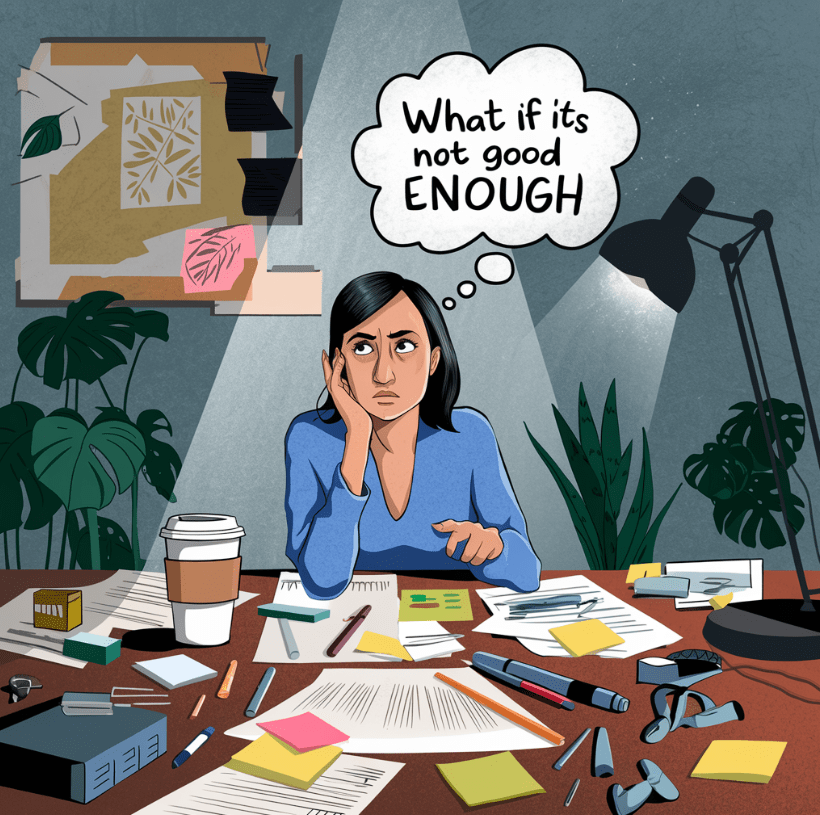
You don’t have to color-code your spice rack or alphabetize your email folders to be a perfectionist.
You might not even look like a perfectionist from the outside.
You might look disorganized. Behind. Chaotic.
(You might even be someone who refers to themselves as “a mess.”)
But underneath the mess?
A deep, quiet pressure to get it exactly right.
To do it once, do it perfectly, and have it make sense the first time — or else.
That’s perfectionism too.
And it’s sneaky!
Perfectionism isn’t always neat.
Sometimes it looks like… doing nothing at all.
Because if it can’t be perfect, you don’t want to start.
Or maybe you start — but you never finish.
Or you finish, but it never feels “ready.” So it just… sits there.
Unpublished. Unsent. Unshared. Unseen.
That text.
That job application.
That book you half-wrote and never opened again.
Not because you didn’t care.
Because you cared too much.
And it sounds like this:
“It’s not ready yet.”
“I just need to fix a few more things.”
“I’m not qualified.”
“If I do this wrong, everyone will know I’m a fraud.”
“This has to be amazing or it’s not worth doing.”
Perfectionism convinces you that good enough is a trap.
That your first try has to be your best try.
That anything less than flawless doesn’t count.
Which is funny, because perfectionism never lets anything feel flawless.
So you keep chasing a finish line that keeps moving.
The worst part?
You end up never getting credit — even from yourself.
Because if you never finish, you never get to feel proud.
If you do finish, perfectionism tells you it still wasn’t good enough.
And when someone else tells you it’s great?
You deflect. You downplay. You secretly think they’re just being nice.
So the thing never gets done.
Or if it does, it doesn’t land the way it should —
because perfectionism already got to it first.
This post isn’t here to fix your perfectionism.
(That would be a very perfectionist thing to try to do.)
It’s just here to name it.
To say: If this is what’s getting in your way, it makes sense.
You’re trying to protect something that matters to you.
That’s not weakness — it’s tenderness.
And we can work with that.
Next up: Executive Dysfunction
When you know what to do — you even want to do it — and still… you can’t seem to start.
Not because you’re lazy.
Not because you’re avoiding.
But because your brain won’t move.
We’ll talk about that next.



 Perfectly Lazy
Leave a comment